
Entity SEO Explained: What It Is, What It Isn’t, and Where to Start
By Uday Salvi
The short answer
Entity SEO means making it clear to search systems who you are, what you do and what you are known for, and keeping those facts consistent on your site and everywhere else you appear. Google’s documentation says structured data can help it understand and tell your organisation apart from others. It also says it does not guarantee that any feature will show up. I haven’t run an entity SEO project myself. Here’s what I’ve learned from studying it and how I’d approach it.
If you have been doing SEO around keywords, you know the routine. Pick a phrase, check its search volume, put it in the title, the headings and the URL, then count how often it appears on the page.
These are the kinds of questions keyword-first SEO is built around:
- What keywords do you want to rank for?
- Who are your top three competitors, and what keywords are they ranking for?
- Short-tail or long-tail keywords?
- How many times is the target keyword mentioned on your main landing pages?
- Can we put the exact focus keyword at the start of every meta title?
- Does every URL include the primary keyword?
None of these are wrong to ask. The problem is that they start with the words and never ask what the business is, who it is for, or why anyone should trust it. Entity SEO starts from the other end.
What an “entity” means, in plain words
An entity is a specific thing that can be named and told apart from similar things: a person, a company, a product, a place, an idea. “Apple” the fruit and “Apple” the company are different entities, even though the word is the same.
Casey Keith, whose teaching I follow, explains the idea well, and separates two terms that people mix up: the Knowledge Graph is Google’s machine-readable store of things and how they relate, and a knowledge panel is the box that sometimes appears in results. Getting a panel is not the goal. Being understood correctly is. See his explanation.
Keyword-first and entity-first, side by side
- Keyword-first asks: what phrase should this page rank for? Entity-first asks: what is this page about, and does it fit clearly with everything else I publish?
- Keyword-first measures repetition. Entity-first measures clarity: one obvious home page for each important thing, with the same facts everywhere.
- Keyword-first treats each page alone. Entity-first treats pages as a connected set around a few topics you can speak on with real experience.
This does not replace keyword research. People still type words into a search box. It changes what you do with the research.
How I organise it: three layers
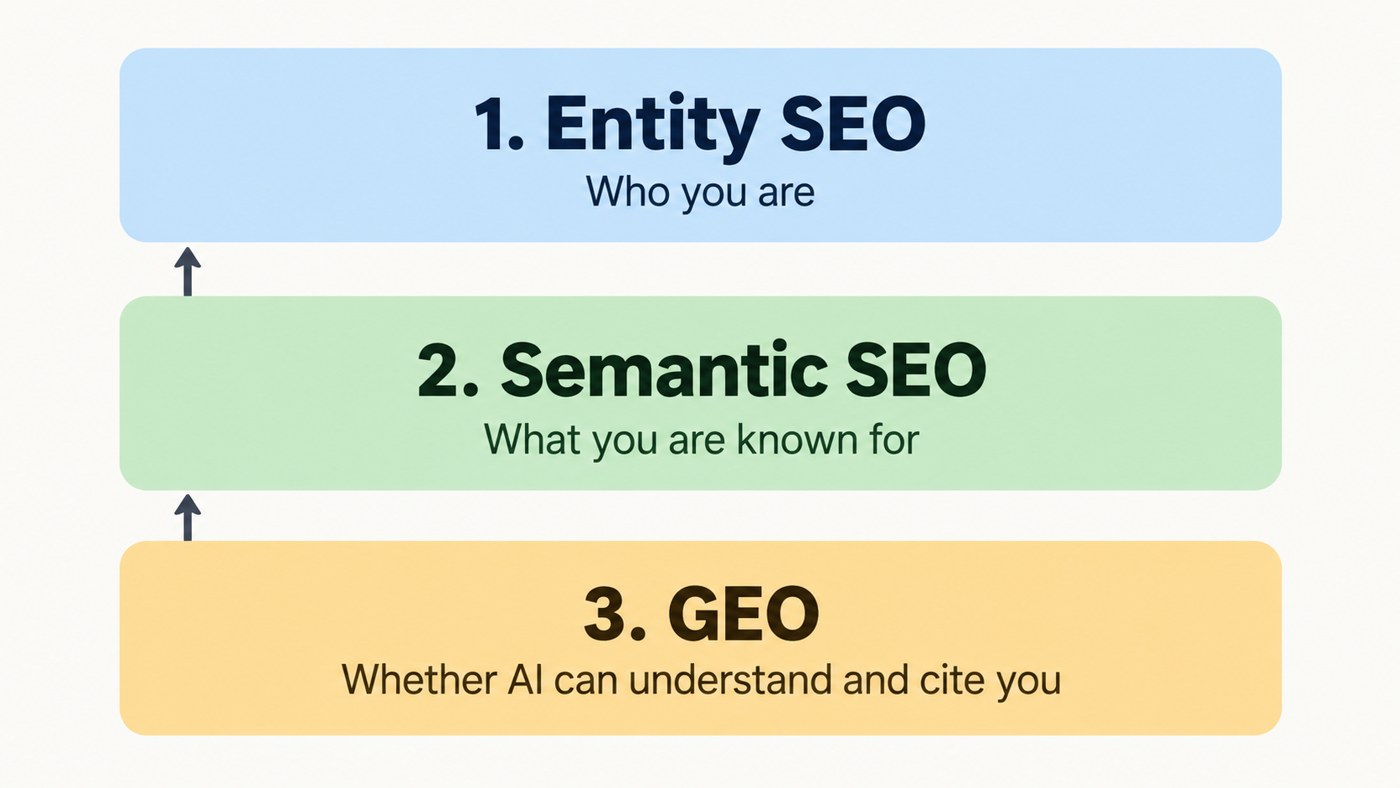
This is my own way of keeping the topic simple. It is a working model, not an official standard.
Layer 1, Entity SEO: who you are
Make sure your brand or name is clearly defined and consistent. That means one page that states plainly who you are and what you do, structured data that describes the same facts, the same name and description on your profiles, and honest signs of credibility such as real experience and real work.
Layer 2, Semantic SEO: what you are known for
Build connected content around the topics you can really cover, instead of isolated posts. A simple shape works: core pages for what you offer, story pages that show real work, and a blog as the supporting layer that answers questions and links back to the core pages. Link them with plain, descriptive anchor text.
Layer 3, GEO: whether AI can understand and cite you
GEO means writing so that AI tools can lift a clear answer: answer first, context-rich sections, and first-hand insight that a generic article lacks.
One honest note on this layer. Google says there are no extra technical requirements for appearing in its AI features, and that the same SEO fundamentals apply. So I treat layer 3 as good writing and clear structure, not a separate trick. Source: Google Search Central, AI features and your website.
Affiliate recommendation
I use Systeme.io, an all-in-one platform for funnels, email marketing and online courses, with a free plan to get started.
Some of the tools and platforms on the site maybe sponsored or contain affiliate links.
What Google actually says
- Organization structured data on your home page can help Google understand your organisation and tell it apart from others. There are no required properties. Add the ones that apply. Source: Google’s Organization structured data page.
- Google does not guarantee that features using structured data will appear in results. Same source.
- Structured data must describe what is actually visible on the page. Marking up content readers cannot see, or misrepresenting who you are, goes against Google’s policies. Source: Google’s structured data policies.
- For AI Overviews and AI Mode, a page must be indexed and eligible to show with a snippet. There are no additional technical requirements, and no specific optimisation is required. Source: AI features and your website.
- Google recommends people-first content, made for readers and not to manipulate rankings. Source: Creating helpful, reliable, people-first content.
Links: Organization structured data, structured data policies, AI features and your website, people-first content.
What I’ve studied, and how I use it
I follow Casey Keith by reading his free content, not through his course. I agree with most of his ideas about modern SEO. I also built a custom GPT using some of his guidelines alongside Google’s documentation. It helps me draft material related to entities, schema and the basic details needed for SEO. That is how I use what I have studied; it is not a tested entity SEO campaign or proof of results.
Casey’s published step-by-step guide covers 12 steps. The core of it: pick one page as the official “entity home” for each main thing, write a clear description in the first 100 to 150 words, add schema that repeats the same facts, and keep your name, description and key facts identical across the profiles you manage. See Step-by-Step: How To Implement Entity SEO.
His About page gives a useful limit for markup: “Structured data can describe those facts. It can’t substitute for them.” That matches Google’s own policy above. Source: About Casey Keith.
I have not tested his method on a project of my own, so I will not tell you it works. I treat these steps as a framework to examine against Google’s documentation, not a guarantee. Anything my GPT drafts still needs checking against the actual business facts and current documentation.
Where I stay sceptical
- Claims that entity SEO will lift your rankings or get you cited by AI. Nobody can promise that, and I found no such promise in Google’s documentation. Treat any promise like that as a sales line.
- Treating schema as the whole job. Markup describes facts that must already be on the page.
- Measuring AI visibility like rankings. In my read, results in AI tools differ by person, place and day, so there is no clean “position 3” to track. Google reports traffic from its AI features inside the normal Web search type in Search Console, not as a separate report.
- Any timeline. Google says recrawling alone can take from several days to several months.
Who this is not for
If you have nothing real to say on a topic, this will not help. Clear structure around thin or generic content is still thin content. And if you need results next month, a slow clarity-building job is the wrong tool. It is not a quick traffic tactic, and I will not suggest it is.
Where I would start on a small site
- Pick one page as the home for who you are. For most small sites that is the About page. Write two or three plain sentences at the top: who you are, what you do, who it is for.
- Add Organization or Person structured data that repeats exactly those facts. Check it in Google’s Rich Results Test.
- Make your name and description match on the profiles you manage, such as LinkedIn and your business listings.
- Choose two or three topics you have real experience in, and link your posts to each other around them with descriptive anchors.
- Write answer-first. Put the direct answer in the first two or three sentences of each post.
Short FAQ
Do I need schema to do entity SEO? No. Google lists no required properties for Organization structured data, and it helps only when it matches what is visible on the page.
Will this get me into AI answers? I can’t promise that. Google says the fundamentals are the same as for regular search, and it does not name a special optimisation.
Does it replace keyword research? No. It changes what you do with the research: group keywords by topic and write for the whole topic, not one phrase at a time.
Next step
Start with the About page. Rewrite the first three sentences so a stranger knows who you are and what you do. See mine for the style: About Uday.
Uday Salvi. I’m Uday, a digital marketing consultant with 20+ years of experience helping businesses grow through digital. More about Uday. “Because being digital isn’t enough anymore – you’ve got to Be Digital Cool.”


Comment:
How to Structure a Blog Post: The Process I Follow Before I Write Anything
October 15, 2026 at 12:16 pm[…] this process: Digital Product Creation: Why Most Beginners Never Finish, The Circle of Misery, my entity SEO post and How to Choose a Profitable Niche […]