
Digital Product Creation: Why Most Beginners Never Finish (and How to Fix It)
Updated: September 24, 2026 – What changed: rewritten with my own examples, a sales-page-first test, a first-10-buyers check, honest time ranges, and a copyable product brief.
If you can’t finish your digital product, the problem is usually not your skill or your discipline. It’s a decision you haven’t made yet: who it’s for, what result it gives them, and where the first buyers will come from. Make those decisions on one page before you build anything, and the product gets smaller, clearer and much easier to finish.
I’ve learned this the hard way. I’ve built products that sold and still didn’t work as a business. This article covers why creators stall, how to decide what to build, how to cut it down to something you can finish, and what to have ready so the effort pays off. At the end there’s a one-page product brief you can copy.
The real reason you’re stuck: it’s a decision problem, not a skill problem
Most people who stall on a product know their subject well. A coach who has helped clients for years can explain their method on a call without notes. A designer can show you exactly how they work. Then they open a blank course outline and freeze.
That freeze isn’t a lack of knowledge. It’s a pile of open decisions. Who exactly is this for? Beginner or advanced? Course or ebook? What do I leave out? What if nobody buys it? Every one of those questions sits in the back of your head each time you try to record a lesson. You end up re-writing module one for the fifth time instead of finishing.
I learned the expensive version of this myself. I created two digital products in two very different niches. One of them was a parenting ebook called The Parenting Toolkit. Both had good offers, and sales covered the ad spend. But neither made a profit, because there was nothing behind them: no upsell, no cross-sell, no affiliate products to offer the people who bought. Sales paid for the ads and little else. That wasn’t sustainable, so I stopped both.
The offers were good. What I skipped was deciding what the buyer does next, and how the business makes money after the first sale. That was the real problem. That’s why this article spends more time on deciding than on building.
The 5 places creators stall
The stall usually shows up in one of five places.
- Idea hopping. You start a product, get halfway, then a better idea shows up. The new one feels exciting because it has no problems yet. If this sounds familiar, the pattern I describe in the Circle of Misery is worth a read.
- “Am I expert enough?” You worry someone more qualified already covers this. But buyers don’t need the world’s top expert. They need someone a few steps ahead who can get them a specific result.
- Scope creep. A simple guide turns into a 12-module course because every topic seems to need a lesson before it.
- Overteaching. You add more content to prove the product is worth the price. More content usually makes it harder to finish, for you and for the buyer.
- Fear that nobody will buy. This one sits under the other four. If you haven’t checked demand, every doubt feels reasonable.
All five get smaller once the decisions in the next sections are made.
Where beginners, coaches and course creators each get stuck
Beginners usually stall on “am I expert enough?” and idea hopping. The fix is to pick a narrow result you can already deliver. If you’re still choosing what area to work in, start with how to select a niche that actually makes money before you think about the product.
Coaches stall because their 1:1 work is custom. Every client is different, so a product feels impossible. The way through is to find the repeatable layer: the steps you walk almost every client through, the worksheets you keep re-sending, the explanations you’ve given a hundred times. That layer becomes the product. The custom part stays in your coaching.
Coaches also get stuck on live vs recorded. You don’t have to choose forever. Recorded lessons suit the repeatable layer. Live sessions suit questions and feedback. A mix often works well: recorded method plus a small live element.
Course creators who have built before stall on scope and overteaching. They know how much work a course is, so they either put it off or make it too big to finish.
Start with the outcome, not the topic
A topic is “Canva for beginners”. An outcome is what the buyer can do after they finish.
Write it as one sentence:
After this product, [buyer] can [result] without [the thing they’re struggling with now].
For example: “After this mini course, a small business owner can make good social media creatives with Canva and AI, consistently and fast, without hiring a designer or spending hours on each post.”
This is not a new idea. Course designers call it backward design: start from the end result and work backwards to the lessons. Vanderbilt University’s teaching guidance describes it as a way to start with the end in mind and work backwards, from goals to evidence to content. Once the outcome sentence is written, you can check every lesson idea against it. If it doesn’t move the buyer toward that result, it goes.
Pick one buyer and one motivation
The outcome sentence names one buyer. Keep it to one. A product for “small business owners, freelancers and students” is really three products.
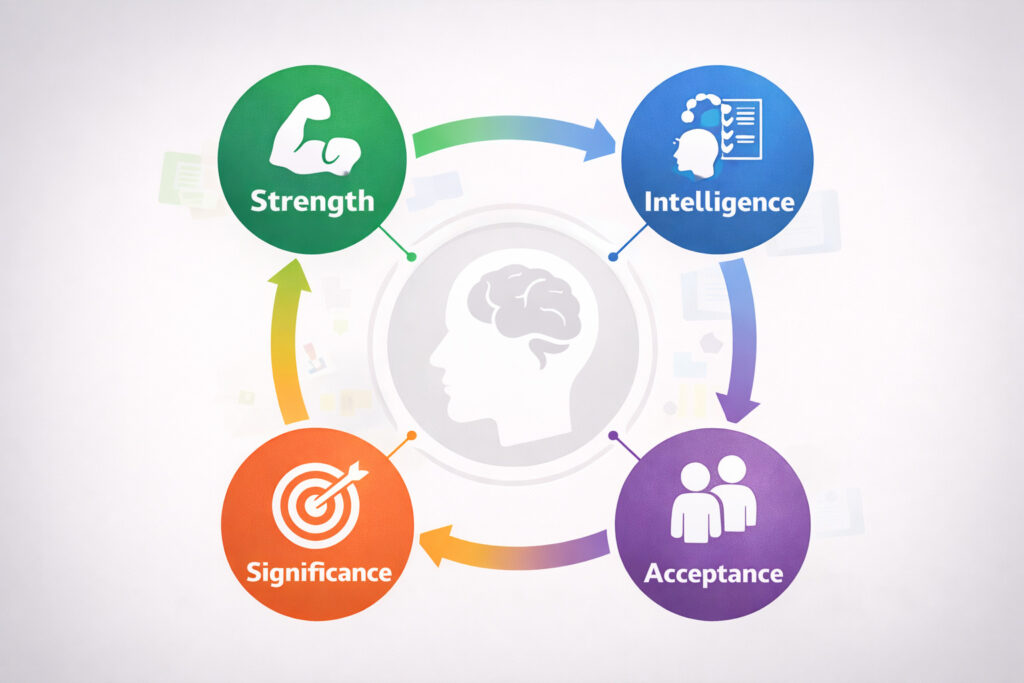
Then decide what drives that buyer. I use a 4-motivation model that I built myself over the years, from many use cases, a lot of reading and analysing campaigns. It’s part of my StoryFlow framework. Every buyer leans mainly on one of four motivations:
- Strength: control and certainty. They want to feel in charge of the result.
- Intelligence: logic and proof. They want to see how it works and why.
- Significance: mastery and standing out. They want to be better than the rest.
- Acceptance: safety and belonging. They want to know people like them have done it.
Most products try to speak to all four and end up saying nothing clearly. Pick the main one for your buyer, and your sales page, lessons and ad creatives get easier to write.
For the Canva + AI mini course, a busy business owner who has tried and failed to keep posting could well be an Acceptance or Strength buyer. They want to know it works for people like them, and they want control over their content without depending on anyone.
Write the sales page before the first lesson
This is the test I’d run before building anything, and it’s the one most “just ship it” advice skips.
Write the sales page first. Headline, who it’s for, what they get, what it costs, and the FAQ a buyer would read before paying. If you can’t write the page, the product isn’t defined yet. Recording lessons won’t fix that.
Amazon has used a similar habit for new products. Werner Vogels, Amazon’s CTO, has described how teams write the press release and the FAQ before building, so it’s clear how the world will see the product, not just how the team thinks about it internally. A sales page does the same job for a solo creator.
When you write the page, speak to what actually makes people buy. From what I’ve seen, buyers of this kind of product are usually driven by three things:
- The feeling of being stuck. They’ve tried and it isn’t working.
- The hope that “it will work this time”. They want a reason to believe this attempt is different.
- Proof that it worked for many other people. They want to see that people like them got the result.
If your page can’t honestly speak to all three, notice where it’s weak. No proof yet? That’s a reason to start small, sell to a few people and collect real results before you build the big version. Don’t fake it.
Know where your first 10 buyers come from
Before you build, write down where your first 10 buyers will come from. Not 1,000. Ten.
Look at what you already have:
- Your email list, if you have one, even a small one.
- Your network on WhatsApp, LinkedIn or wherever your people talk to you.
- Your current or past clients, who already trust you.
- Communities you’re active in, where the buyer already hangs out.
If you can’t name where 10 buyers come from, you have a distribution problem, not a product problem. Fix that first, or plan for paid ads and treat them as part of the product’s cost from day one. That’s where my two products went wrong: the ads worked, but the numbers only worked on the first sale.
Affiliate recommendation
I use Systeme.io, an all-in-one platform for funnels, email marketing and online courses, with a free plan to get started.
Some of the tools and platforms on the site maybe sponsored or contain affiliate links.
The 5-layer product skeleton
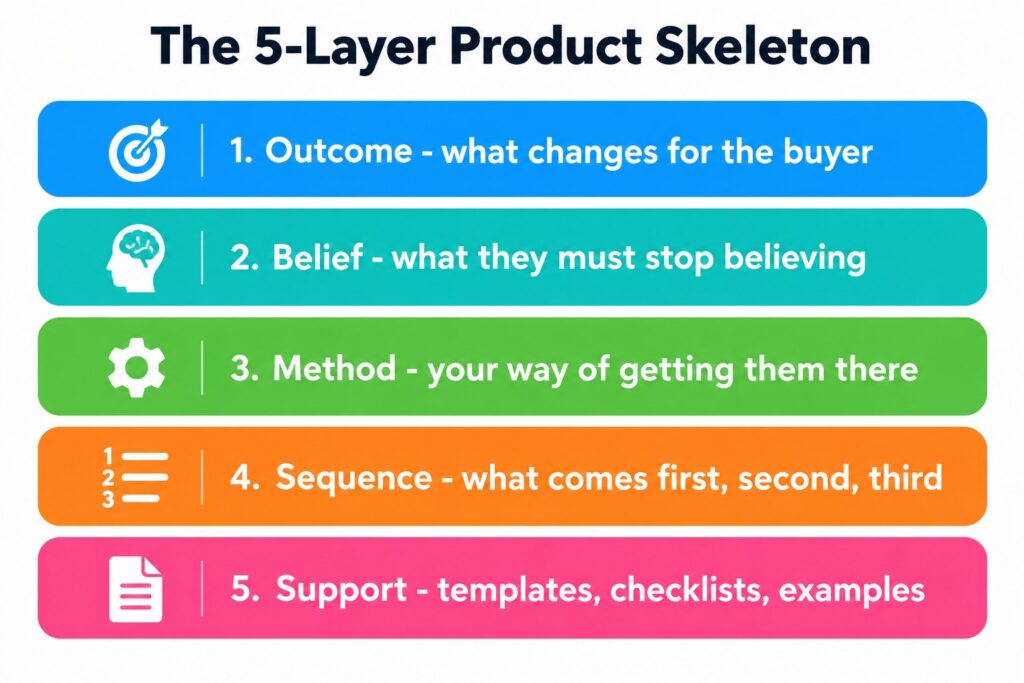
Before any lessons or modules, define five layers:
- Outcome layer: what changes for the buyer.
- Belief layer: what they have to stop believing.
- Method layer: your way of getting them there.
- Sequence layer: what comes first, second, third.
- Support layer: what removes friction (templates, checklists, examples).
Here’s how it looks for the Canva + AI mini course:
- Outcome: the buyer produces good creatives for their business, consistently and fast.
- Belief: “I’m not a designer, so my posts will always look amateur” and “AI images look fake”. Both need to go.
- Method: a repeatable process, for example set up brand basics once in Canva, use AI for ideas and first drafts, then finish in Canva so everything looks consistent.
- Sequence: brand setup first, then one post type done start to finish, then batching a week of content.
- Support: ready-made templates, a prompt list, a weekly batching checklist.
That skeleton fits on one page. Lessons come after it, and each one has a clear job.
Cut scope: pick the smallest product that delivers the outcome
Once you have the skeleton, ask: what’s the smallest product that gets the buyer the outcome?
- Checklist or template: best when the buyer knows what to do but needs a shortcut or structure. Smallest to build.
- Mini-guide or ebook: best when they need the method explained, but not shown step by step.
- Mini course: best when they need to watch it being done, like a Canva workflow.
- Full course: best when the outcome really needs several stages, practice and feedback.
Be honest about time. A full product took me about six months while I was working a full-time job. A lot of advice suggests you can build one in a few weeks. That may be true for a checklist. It usually isn’t for a full course when you have a job and a life. A checklist or template is days of work, a mini-guide or mini course is a few weeks, a full course can take months.
If you’re working full time, start with the smallest format that delivers the outcome. You can build the bigger version later, once people have bought the small one.
Validation signals that actually mean demand
Engagement is not demand. Likes, comments saying “great idea” and people telling you “I’d buy that” feel good, but they cost nothing.
Signals that mean more:
- People pay. A pre-sale, a paid pilot or a waitlist with a deposit.
- People ask for it without prompting. The same question keeps showing up from clients or your audience.
- People already buy something similar. Other products on the same problem have sales and reviews. My 3-minute validation check walks through a quick way to look at this on marketplaces.
- People use your words back to you. When buyers describe the problem in the same language as your sales page, the page is working.
Also note the objections you hear. Every “but what if I…” belongs in your sales page FAQ.
What I’ve seen go wrong
Let me go back to The Parenting Toolkit, because one number from it sticks with me. It sold 500 copies. At the time I had no funnel behind it, so there was nothing to upsell to those 500 buyers. No next product, no course, no affiliate offer. Five hundred people trusted me enough to buy, and I had nothing to offer them next.
My other product went the same way. In both cases the front-end offer worked and sales covered the ads, but nothing came after the first purchase, so there was no profit. That’s why I stopped both.
The lesson: a product that sells is not the same as a business that works. Before you build, sketch what a buyer can get next:
- Upsell: a bigger or faster version of the same result.
- Cross-sell: a related product that solves the next problem.
- Affiliate products: tools or products you’ve actually used that help the buyer get the result.
You don’t need all of them on day one. But you need to know what they’ll be, because that’s what decides whether paid traffic can ever be profitable.
Your one-page product brief
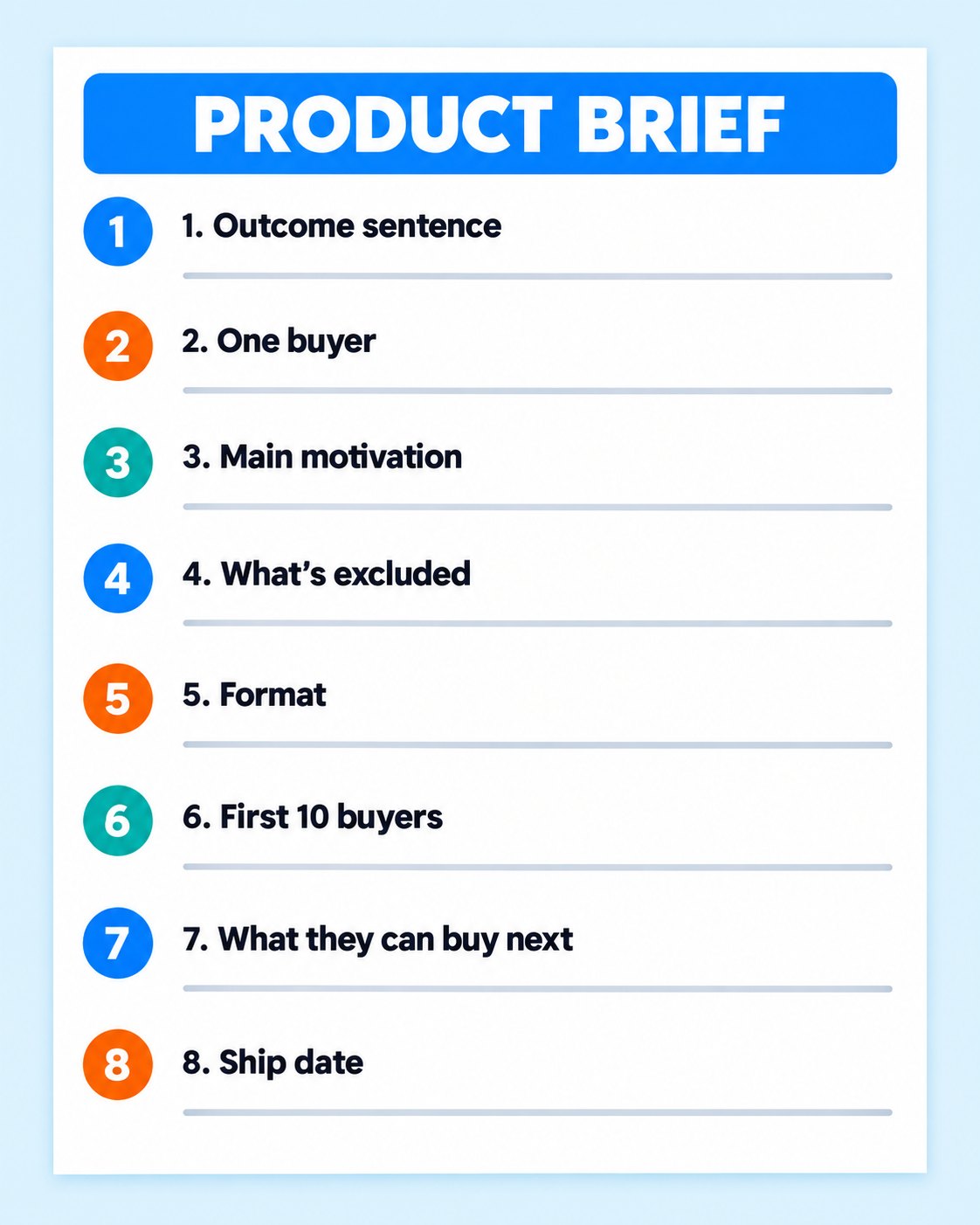
Copy this and fill it in before you build anything. If a line is hard to fill, that’s the decision you’ve been avoiding.
PRODUCT BRIEF
- Outcome sentence: After this product, [one buyer] can [result] without [current struggle].
- One buyer: Who exactly (role, situation, what they’ve already tried)
- Main motivation: Strength / Intelligence / Significance / Acceptance (pick one)
- What’s excluded: Topics, levels and buyers this product is NOT for
- Format: Checklist / template / mini-guide / mini course / full course
- First 10 buyers: Where they come from (list, network, clients, community, ads)
- What they can buy next: Upsell / cross-sell / affiliate product
- Ship date: The date the first version goes on sale
Here it is filled in for the Canva + AI example:
- Outcome sentence: After this mini course, a small business owner can make good social media creatives with Canva and AI, consistently and fast, without hiring a designer.
- One buyer: a small business owner who posts on social media themselves and keeps falling behind.
- Main motivation: Acceptance.
- Excluded: professional designers, video editing, paid ads strategy.
- Format: mini course.
- First 10 buyers: [your list, network, clients or community].
- Next purchase: [your upsell, cross-sell or affiliate offer].
- Ship date: [a real date].
Action steps
- Write your outcome sentence today. One buyer, one result.
- Write the sales page and its FAQ before any lesson. If you can’t, go back to step 1.
- List where your first 10 buyers will come from.
- Pick the smallest format that delivers the outcome, and put a ship date on it.
- Decide what a buyer can get next before you spend money on ads.
FAQ
What should my niche be?
Pick a specific group with a clear problem they already spend money on, where you can deliver a result. Don’t pick on passion alone. My guide on how to select a profitable niche goes through it step by step.
How much should I spend daily on ads?
For a digital product priced between $9 and $37, I’d start with a minimum of $20 a day, using money you can afford to lose while you test. Don’t scale until you know two things: what one sale costs you in ads, and what a buyer is worth after the first sale. If sales only cover ad spend, like mine did, spending more won’t make a profit. A funnel behind the product will.
What type of creatives should I make?
Creatives that speak to your buyer’s main motivation. For an Acceptance buyer, show people like them getting the result. For an Intelligence buyer, show how it works. For a Strength buyer, show control and certainty. Test a few versions and keep the ones that sell, not the ones that get likes.
Who should I target?
The one buyer in your outcome sentence. If your targeting is broader than your sales page, you’ll pay for clicks from people the product isn’t for.
How long does it take to create a digital product?
It depends on the format. A full product took me about six months alongside a full-time job. A checklist or template is far quicker. Start with the smallest format that delivers the outcome.
If you’re stuck on a product right now, stop building for a day. Fill in the brief. Write the sales page. Name your first 10 buyers and what they’ll buy next. The product you finish might be smaller than the one you planned, and that’s fine. A small product that sells, with something behind it, beats a big one that never ships.
If the problem is that you keep starting and stopping, read why creators get stuck in the Circle of Misery next.
About the author
Uday Salvi. “I’m Uday, a digital marketing consultant with 20+ years of experience helping businesses grow through digital.” More about Uday
Because being digital isn’t enough anymore – you’ve got to Be Digital Cool.


Comments:
Why You Keep Starting and Quitting Online (and How to Stop)
October 8, 2026 at 9:13 am[…] you are still choosing what to build, my post on why most beginners never finish a digital product covers that […]
How to Structure a Blog Post: The Process I Follow Before I Write Anything
October 15, 2026 at 11:50 am[…] posts on this site were rebuilt with this process: Digital Product Creation: Why Most Beginners Never Finish, The Circle of Misery, my entity SEO post and How to Choose a Profitable Niche […]