Before You Turn On Google AI Max: Check Lead Quality and Landing Pages
Before turning on AI Max, check which website pages can receive paid traffic and decide what a qualified lead looks like. More enquiries are useful only if they bring the right people at a cost the business can support.
I have run Google Ads campaigns using AI Max and Performance Max. In campaigns I have worked on, one of the first things I noticed after enabling AI Max was more leads. But lead quality needed close attention. Some searches were not closely aligned with the offering or the intended buyer.
That is my experience, not a promise that every campaign will get more leads. The outcome depends on the business, market, budget, bidding strategy and starting point. The question I would ask is not just how many forms arrived. It is how many became genuine business opportunities.
1. What AI Max changes, and what it does not
AI Max is a set of features inside a Google Search campaign, not a standalone campaign type. It gives Google more flexibility in matching searches, generating ad text and choosing landing pages.
Google groups the features into search term matching and asset optimisation. For an advertiser, three controls are worth understanding:
- Search term matching expands beyond existing keywords using broad-match and keywordless technology. Google can learn from keywords, creative and URLs when deciding which searches to match.
- Text customisation uses existing ads, landing-page text and other assets to generate ad copy for a search.
- Final URL Expansion can send a person to another relevant page on your domain rather than always using the original landing page.
Google says these settings are enabled by default when you opt in to AI Max, with controls to turn them off at the relevant campaign or ad-group level. Final URL Expansion requires text customisation. Check the actual settings before testing rather than assume they match what you intended.
Google: how AI Max for Search works
2. AI Mode, AI Max and Performance Max are different things
AI Mode is the conversational search experience people use. AI Max is the automation layer inside a Search campaign. Performance Max is a separate campaign type. Running AI Max does not mean you have selected an AI Mode placement or proved that AI Mode produced a result.
Google has announced tests of new ad formats in AI Mode. A product announcement does not establish availability in every account or market. This article focuses on the Search controls I have used, not on a claim that I have measured AI Mode advertising separately.
Google: about AI Max and its difference from Performance Max
Google: announced AI Mode ad tests
3. The vendor page that attracted the wrong audience
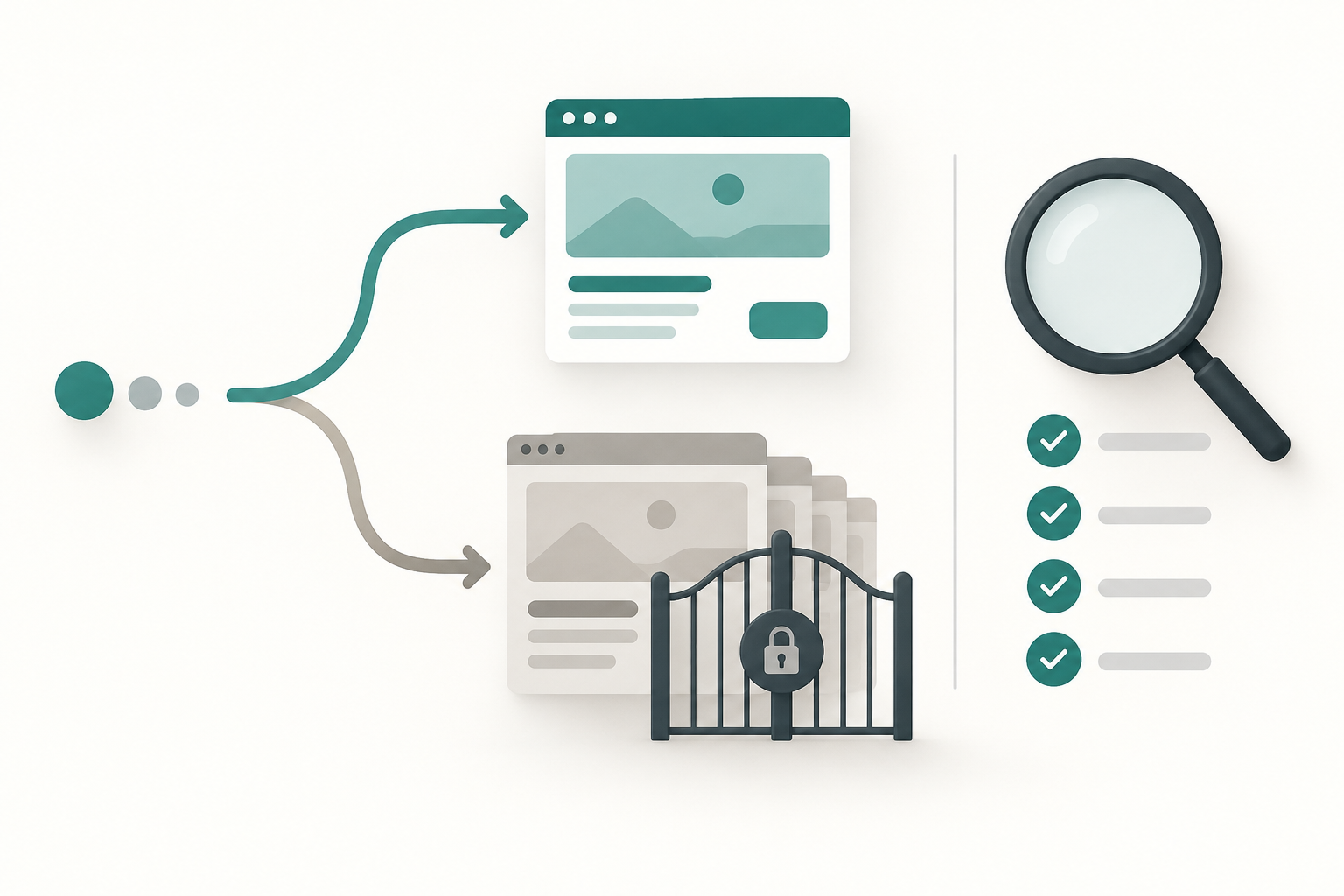
In one campaign for a high-end service, I enabled AI Max with Final URL Expansion. The website had a page intended for vendors rather than people looking to buy the service.
Ads started directing people to that page, and vendor enquiries came in. The problem was not simply whether the page mentioned something relevant. It was whether the audience arriving there matched the purpose of the campaign.
I excluded the vendor page and other irrelevant pages. That is the action I took. I am not attaching a before-and-after performance claim to it here.
The lesson is to define which pages are eligible for paid traffic before expanding it. A page can be useful to a business without being a suitable destination for a buyer-acquisition campaign.
4. Audit your landing pages before giving Google more choice
Start with a page list. For each page, ask who it is written for, what it offers and what the visitor should do next.
- Buyer-facing service pages: do they clearly explain the offer, service area, benefits and qualification criteria?
- Vendor, recruitment and partner pages: do they serve the audience this campaign is trying to acquire?
- Support and existing-customer pages: are they useful to prospective buyers, or would paid traffic bring the wrong enquiries?
- Other pages: judge their role rather than exclude every page without a price or purchase button. A useful buyer information page may still support the campaign.
Google supports excluding individual URLs and using rules for URL exclusions in Final URL Expansion. Check a rule carefully so it does not also catch a page you want buyers to visit. URL exclusions control landing-page selection; negative keywords address unwanted search matches. They are different checks.
There is another control to review if a message must appear exactly as written. Google says pinned responsive search ad assets are not used when Final URL Expansion selects a more relevant URL; URL inclusions can also affect pinning. Do not treat a pinned headline as a guarantee while those settings are active.
Google: Final URL Expansion, exclusions and pinned assets
5. Define a qualified lead before the campaign starts
I typically evaluate four things before classifying a lead as a sales qualified lead, or SQL:
- Service fit: does the person need the specific service being offered?
- Location: is the person in an area the business serves?
- Budget: is their budget realistic for that service?
- Readiness to buy: are they genuinely considering the service within a reasonable timeframe?
Use agreed qualifying questions and apply the criteria consistently. They will vary by business. For a high-end service, budget and readiness may matter more than for a lower-priced offer.
A form submission is an enquiry. It should not automatically be treated as a qualified sales opportunity. Deciding that distinction before launch gives you something meaningful to measure when the volume changes.
Affiliate recommendation
I use Systeme.io, an all-in-one platform for funnels, email marketing and online courses, with a free plan to get started.
Some of the tools and platforms on the site maybe sponsored or contain affiliate links.
6. Review the searches, destinations and outcomes together
Once AI Max is running, review the actual search terms and landing pages alongside the enquiries they generate. Add irrelevant searches to your negative keyword list, but do not mistake a clean-looking search report for proof of good lead quality.
Google documents AI Max reporting for search terms, headlines and selected URLs. Use that to understand how a person reached the offer, then compare it with what happened after the enquiry.
- Spend and cost per enquiry: what does it cost to generate a form submission or other tracked enquiry?
- Qualified leads: how many enquiries meet the criteria you agreed?
- Qualification rate: qualified leads divided by enquiries, using a consistent cohort and time window.
- Cost per qualified lead: spend divided by qualified leads from the same cohort.
- Sales outcomes: what happens after qualification, once there has been enough time to judge?
These are different views of performance. A lower cost per enquiry can look attractive while more of those enquiries fail to qualify. Equally, a longer sales process means fresh enquiries may need time before their outcome is known. Do not compare an unfinished group with one that has had time to close.
My test is whether the campaign generates more qualified leads at an acceptable acquisition cost, not whether the form count looks impressive.
Google: available AI Max reporting
7. Close the loop with reliable qualification and sales data
My recommendation is to feed qualification and customer outcomes back into Google Ads, rather than optimise only for form submissions. This is a recommendation here, not a claim that I implemented the following setup in the vendor-page campaign.
Google recommends enhanced conversions for leads for offline lead measurement. It supplements imported outcomes with user-provided first-party data, such as email addresses, matched using hashed data. It can also use Google Click IDs, or GCLIDs, alongside that data.
A traditional GCLID-based process stores the click identifier with the lead, then imports the later qualification or sales outcome. Enhanced conversions for leads is an upgrade to offline conversion measurement, not an unrelated alternative that can never use a click ID.
This needs a reliable connection between the original enquiry and its later outcome, appropriate customer-data permissions and consent, correct tagging and a working import process. Hashing is not permission to collect or share personal data. Review Google’s data requirements and diagnostics before relying on the setup.
If qualified-lead or customer outcomes are used for bidding, check the campaign’s conversion goals and which actions are primary. For value-based bidding, values should reflect real business priorities. Do not add invented stage values or count the same outcome twice simply to make the reporting look better.
Use Google’s current setup documentation for the implementation. Its documentation contains migration notices and some older API references, so a generic copied tutorial is not enough. This article is a decision checklist, not a click-by-click installation guide.
Google: enhanced conversions for leads
Google: upgrading offline conversion imports
8. A pre-launch checklist you can copy
- Write down the enquiry, qualified-lead and customer outcomes separately.
- Agree service-fit, location, budget and readiness criteria.
- Check that conversion tracking records the intended actions reliably.
- List the landing pages buyers should reach, then review exclusions for other audiences.
- Check whether text customisation, URL expansion and pinning behave as you need.
- Set a test budget the business can support, and decide what would make you stop or change the test.
- Review searches, landing pages, spend and lead quality together.
- If importing later outcomes, verify matching, consent, diagnostics and bidding goals before relying on them.
If you cannot tell which enquiries qualify, or your pages blur buyers and other audiences, fix those gaps before using a bigger enquiry count as a success signal. A test cannot answer a business question you have not defined.
9. The point is better opportunities, not more activity
AI Max gives Google more room to find searches and choose how the offer is presented. That can be useful. It also makes the quality of your website and your definition of a good lead harder to ignore.
In the campaign I described, a vendor page was relevant to the wrong audience. Excluding it was a practical way to narrow the pages eligible for paid traffic. The wider discipline is the same: define the buyer, check the destination and measure what happens after the form.
If you also run Meta campaigns, my article on what I still control when AI builds Meta ads covers the same question on a different platform: which decisions should stay with the advertiser?


