Why You Keep Starting and Quitting Your Online Business, and How to Break the Loop
Updated: October 8, 2026. Rewritten with my own numbers and stories.
The short answer. In my experience, people keep quitting for two reasons. They wait for a perfect idea and jump to the next shiny one, or they run ads with no funnel behind them, so the money never adds up. You can break the loop by deciding, before you launch, what you will test, for how long, and what you will do if sales cover your costs but leave no profit.
I have quit twice when a project was close to working. Looking back, there was more to it than the idea itself.
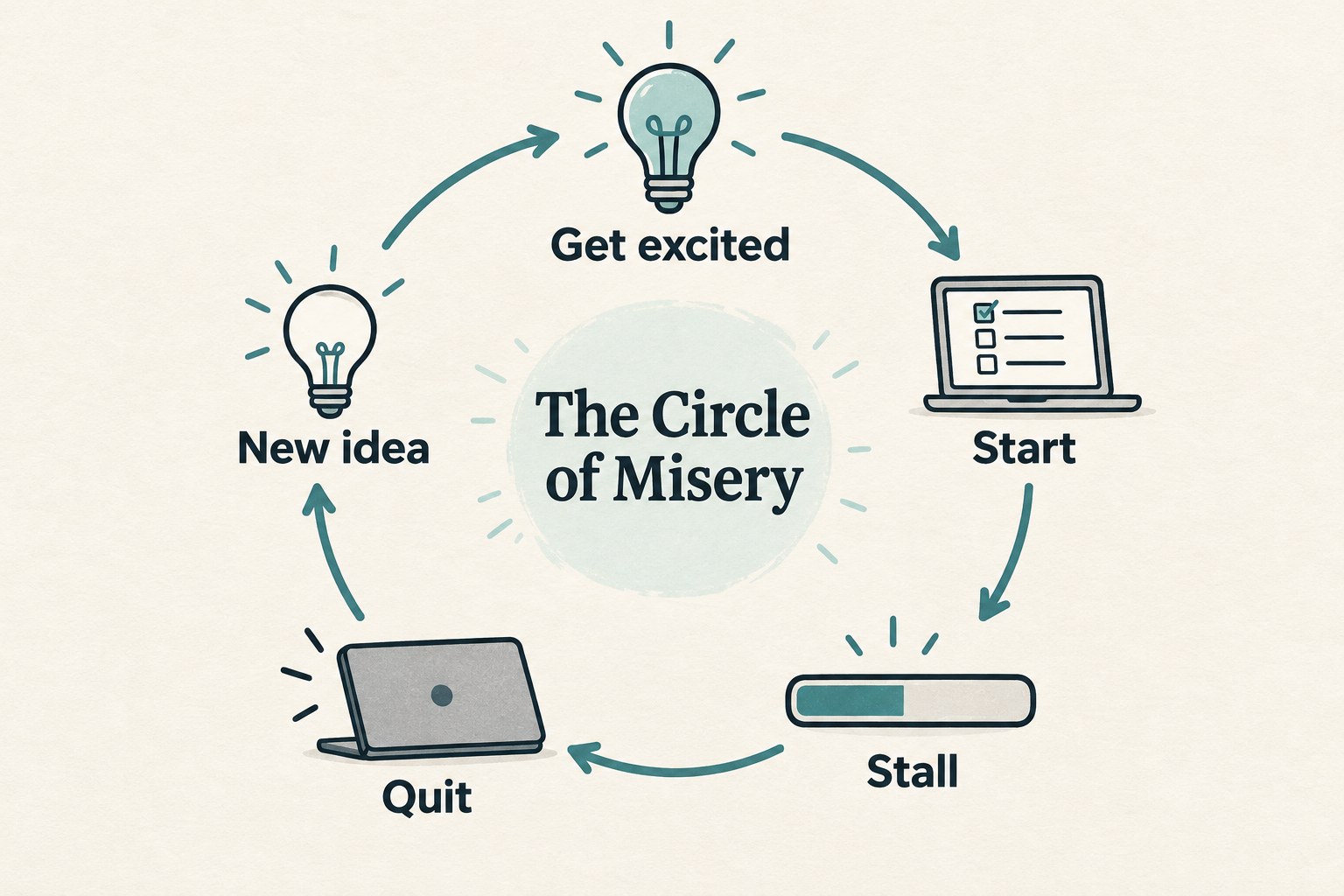
I think of this pattern as the Circle of Misery. I do not claim to have coined the term. The loop is simple: get excited, start, stall, quit, then chase a new idea. This post is about why the loop happens and what I would do differently.
Two times I quit when I was close
The ebook that paid for its ads but not for me
I launched an ebook and ran Meta ads to sell it. The offer was good. I sold 500 copies and made over Rs 1.5 lakh (150,000 Indian rupees) in sales.
That money covered my ad spend, but it did not leave me a profit. There was nothing behind the ebook: no follow-on product, no upsell, no cross-sell. Every sale cost about what it earned. After a considerable stretch of running the ads with no profit in sight, I stopped.
The SaaS I tested but never launched
The second time I was building a SaaS product with the working name AI Strategist. It was intended to analyse an ad campaign before any money went into ads: the creatives, copy, offer and landing page, along with current paid-ad trends on different platforms. The idea was to predict whether a campaign might work, then explain what to change and why. It was never launched, so this is what I was building, not a claim about a live product’s accuracy.
I tested everything. What stopped me was the last step, deployment. It was too technical for me, and I was not ready to pay someone to finish it and launch it.
The product was not the problem in either case. In the first, the numbers stopped working. In the second, I hit a step I had not planned for and did not want to pay for.
Where people quit, from what I see
I quit after the ad spend. These are the two other places I see people quit or never start:
- They wait for the perfect idea or the perfect setup. While they wait, another shiny object shows up, and the cycle starts again.
- They run ads but have no funnel to cross-sell or upsell. Without that, they cannot turn sales into profit, so they cannot replace a 9 to 5 income. They feel stuck and stop.

Why the loop is not a discipline problem
This is my read, not a study. The gaps were different: no follow-on offer after the ebook sale, and no plan to get past deployment for the SaaS. I also had no rule I had set in advance for when to push and when to stop.
Without a rule, quitting is a mood. On a bad week it feels right. With a rule you set before launch, quitting or continuing is a decision you can check against numbers.
Affiliate recommendation
I use Systeme.io, an all-in-one platform for funnels, email marketing and online courses, with a free plan to get started.
Some of the tools and platforms on the site maybe sponsored or contain affiliate links.
How to break the loop
I do not have a fixed quit-or-push rule myself. What follows is a suggested way to set your own, built from my two quits.
- Pick a product you can finish and sell. My estimate from idea to first sale is about a week for an ebook and about 45 days for a SaaS, at around 2 hours a day. These are estimates, not promises. The SaaS I describe here never launched.
- Before you spend anything, write down three limits: the most you will spend on ads, how long you will run the test, and how many sales or conversations count as a real signal. Use your own numbers.
- Plan the next offer before you run ads. My ebook sold, but with nothing behind it, sales only covered the ad cost. An upsell, a cross-sell or a follow-on product is what can turn break-even into profit.
- List the one step you cannot do yourself. For my SaaS it was deployment. Decide early whether you will learn it, pay for it, or choose a simpler product.
- When you reach your limits, decide from the numbers you wrote down, not from how the week felt.
Who this is not for, and what it costs
- Paid ads cost real money, and you can lose it. In my ebook case the ad spend came back, but I made no profit from it.
- The timelines above are my estimates, at about 2 hours a day. Yours will differ.
- This post does not promise a first sale or any income.
If you want a guided path to your first sale
I put together The First Sale System as my own named offer. When you buy it, you get access to a course by another creator that helps people make their first sale. I have the rights to sell that course.
You do not need it to use anything in this post. It is one option if you want a structured course to follow.
What to do next
- Write your three limits (spend, time, sales or conversations) before your next launch.
- Sketch the second offer you would put behind the first.
- Name the step you would be tempted to quit at, and decide how you will handle it.
If you are still choosing what to build, my post on why most beginners never finish a digital product covers that part.
Questions I get
How long should I spend on ads?
I do not have a fixed number. Set a time and spend limit before you start, and judge the result against profit, not only against whether sales came in. Sales that only cover ad cost, like mine did, are a sign something is missing behind the offer.
When can I expect the first sale?
My estimate is about a week from idea for an ebook and about 45 days for a SaaS, at around 2 hours a day. My ebook sales came from Meta ads. The SaaS in this story never launched, so do not read the estimate as a claim that it made a sale. These are not guarantees.
When should I scale?
I look for two things before scaling: you are making a profit, and you have another product to sell, upsell or cross-sell. Sales that only recover the ad spend are not enough.
How do I set up a campaign on Meta?
My advice: start with a daily Meta budget of at least twice the selling price of your digital product. Give the campaign at least 10 days. Add 4-6 creatives, using a mix of static images and videos. Keep the creatives simple; do not try to be clever. Keep targeting broad and let Meta’s system do the work. This is my suggested starting point, not a guarantee. Paid ads can lose money.


Comments:
Digital Product Creation: Why Most Beginners Never Finish
September 24, 2026 at 10:21 am[…] feels exciting because it has no problems yet. If this sounds familiar, the pattern I describe in the Circle of Misery is worth a […]
How to Structure a Blog Post: The Process I Follow Before I Write Anything
October 15, 2026 at 11:51 am[…] site were rebuilt with this process: Digital Product Creation: Why Most Beginners Never Finish, The Circle of Misery, my entity SEO post and How to Choose a Profitable Niche […]