
Short answer: pick a niche people already spend money on, then narrow it to a micro niche inside it. Check five things before you commit: the trend, the video and search competition, who gets the traffic, whether anyone pays for ads, and whether you can stand out in one small corner.
I’m Uday, a digital marketing consultant with 20+ years of experience helping businesses grow through digital. I use the quick checks below whenever I look at a niche. This guide is for beginners starting a side hustle with digital products or online money-making.
What a profitable niche actually is
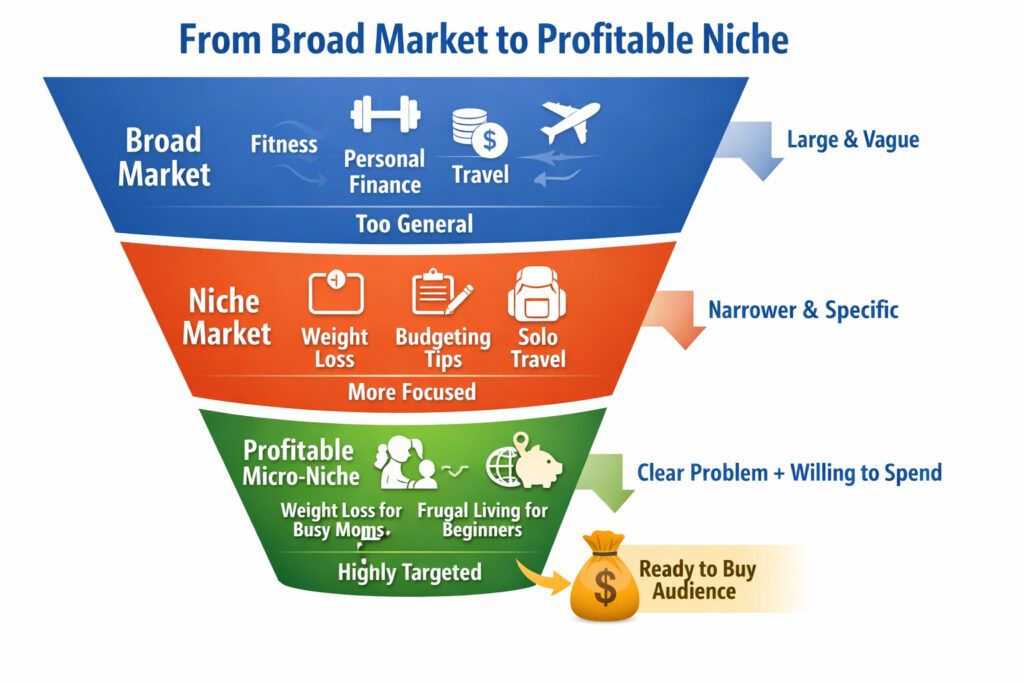
A profitable niche is a specific group of people with a clear problem who already spend money trying to solve it. It is not a broad topic like “fitness” or “make money online”, and it is not just whatever is trending.
Step 1: Check the trend
Open Google Trends and type in the niche. You want to know whether interest is growing, flat or falling. Compare two or three phrasings of the same idea, because one niche is often searched in different words. Google explains how comparing terms works here: Compare Trends search terms.
Step 2: Look at YouTube and Google
Search the niche on YouTube and see how many videos already cover it. Then search it on Google and see who ranks, and what kind of pages they are: blogs, courses, tools or big brands.
Plenty of videos and blogs is not bad news. In my experience, a lot of competition usually means people are making money in that niche. No competition at all usually means no market.
Step 3: See who gets the traffic
Use SimilarWeb to note the top five sites in the niche by traffic. This shows who you are really up against, and whether small creators or big companies win.
Step 4: Check whether people pay for ads
Look for ads on that niche or sub-niche. If someone is spending money on ads, that is a strong sign there is money in it, and it is worth exploring. It is one of the most important checks I do.
Step 5: Find the micro niche
In my experience, in a crowded niche the top 5 to 10 percent of players make most of the money, roughly 90 percent, and everyone else shares the rest. That is my own rule of thumb from watching markets, not a published statistic. In a huge, growing market like AI, nearly everyone earns something. But a beginner wins by finding a micro niche inside the popular niche and focusing only on that.
Here is what narrowing looks like inside a big niche like weight loss. These are examples of how to narrow a niche, not health advice:
- Weight loss for night shift workers. The audience is people who work unconventional hours, such as nurses, security guards and factory workers, whose routine is shaped by disrupted sleep and late-night eating.
- Weight management for people living with chronic fatigue syndrome (ME/CFS) or fibromyalgia. The audience is people who want to manage their weight but find regular exercise very hard because of pain or exhaustion.
- Weight management after orthopaedic surgery. The audience is people recovering from major joint surgery, such as a knee or hip replacement, or a serious injury, who are less mobile for a while.
Each one is a small, clear group with a specific problem, which is much easier to serve than “weight loss” for everyone.
Affiliate recommendation
I use Systeme.io, an all-in-one platform for funnels, email marketing and online courses, with a free plan to get started.
Some of the tools and platforms on the site maybe sponsored or contain affiliate links.
A real example: Canva plus AI content
When people first started using AI to create content, Canva was the most popular design tool for non-designers. I checked it the way described above. There were already plenty of blogs and YouTube videos on it. I went ahead anyway: I built a basic course, added a course from a reputed creator as an upsell, and put a Canva graphics add-on on the cart page. I sold 200+ copies globally (approximate, not an exact count).
I stopped when the market was flooded with similar courses and AI tools got better at creating images on their own. I no longer have the original numbers, so I won’t quote any. The lesson: a crowded niche can still sell, but timing and a clear angle matter, and so does knowing when to leave.
Four mistakes I see beginners make
- Getting in too late, when the market is already saturated.
- Not finding a micro niche, so they compete head on with everyone.
- Trying several niches at once, so none gets enough time.
- Not quitting when the signals say the niche is dying or being replaced by something else.
Quick checklist before you commit
- Is interest growing, or at least steady, on Google Trends?
- Are there videos and blogs already, so people care?
- Do you know the top five sites by traffic?
- Is anyone paying for ads in this niche or sub-niche?
- Can you describe your micro niche in one sentence?
- Do you know what signal would make you stop?
Free ebook offer
Finding Your Profitable Online Niche – Complete Guide. Free in exchange for an email address.
A beginner-friendly, step-by-step guide to finding a niche and checking that there is real demand for it, built around a 7-day process.
Free bonuses included: a 7-day niche selection worksheet, a niche research tracker, competitor analysis and keyword research templates, content planning templates, action checklists and a quick reference guide.
Questions beginners ask
Can beginners still find a profitable niche? Yes, usually by going narrower, not broader.
Is competition bad? In my experience, no. It usually means people are paying.
Should I try a few niches at once? I don’t recommend it. Give one niche enough time.


Comments:
Digital Product Creation: Why Most Beginners Never Finish
September 24, 2026 at 10:21 am[…] result you can already deliver. If you’re still choosing what area to work in, start with how to select a niche that actually makes money before you think about the […]
AI Can Build Your Meta Ads. What Should You Still Control?
October 12, 2026 at 6:05 pm[…] AI can find an audience, but you still need to know exactly who your buyer is. Read How to Choose a Profitable Niche Online: 5-Step Check. […]
How to Structure a Blog Post: The Process I Follow Before I Write Anything
October 15, 2026 at 12:29 pm[…] These posts on this site were rebuilt with this process: Digital Product Creation: Why Most Beginners Never Finish, The Circle of Misery, my entity SEO post and How to Choose a Profitable Niche Online. […]